Artist statement
2026
I work from the body, because the body is the only place where anything really happens. It is a cage, a tool, a vessel.
The only filter through which reality enters. Everything begins in the material world for me: thought, impulse, impact.
I usually understand things only after I push against them. When I break them. When I force them together. Or when
they push back.
I often think about existence as something stretched between two poles. On one side there is animality: instinct, pressure,
the urge to survive, raw experience before interpretation. On the other side there is the structure of reality.
Physical laws. The order that keeps the world from falling apart. Reality itself feels precise and indifferent, a network
of principles that organizes everything while experiencing nothing. The human being stands somewhere in between.
Intelligent enough to impose structure on the world, but still animal enough to remain trapped in a body. That tension
matters to me. Most of my work grows out of that narrow space.
The materials I use are not metaphors. They carry temperament.
Wax feels close to tissue. Fast, hot, smoky. Almost bodily.
Bone carries the memory of an animal. A trace of something that once wanted to continue living.
Clay, concrete, stone or metal resist in different ways. They demand physical confrontation.
Many works begin with destruction. A strike that breaks an existing structure and opens space for something else.
Violence and precision are not opposites for me. They belong to the same movement. Brutality is a method, not an
aesthetic. When a work becomes too controlled, I have to interrupt it. Break it open. Often it is only after something
collapses that it becomes clear what should remain.
Studio view

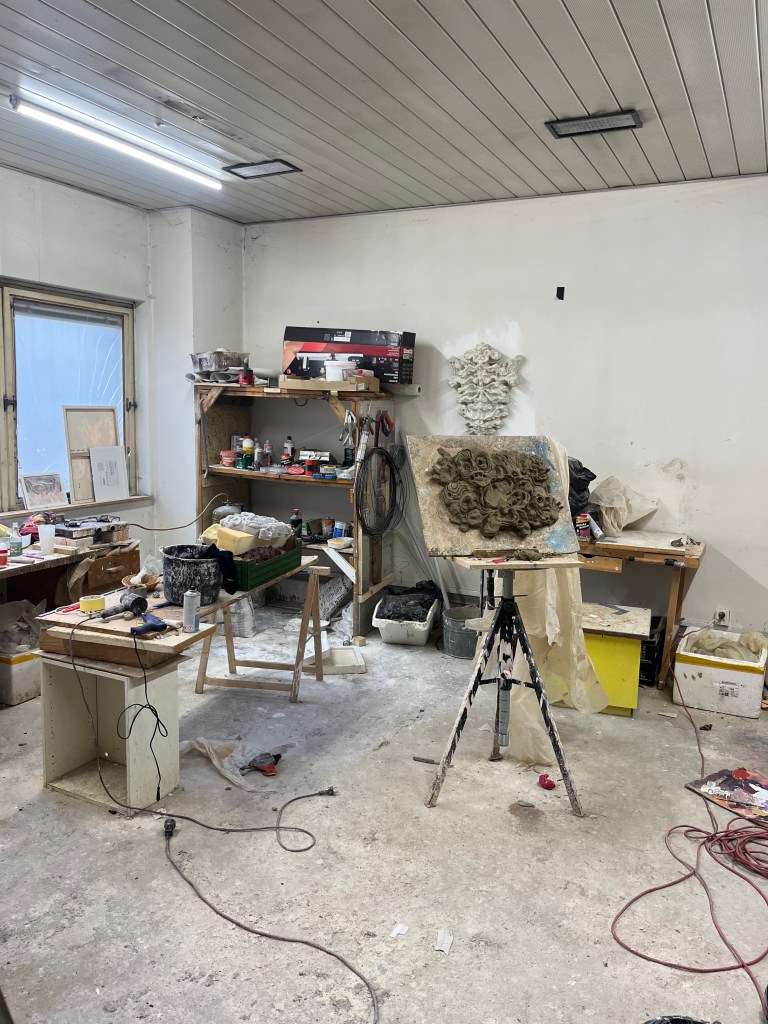
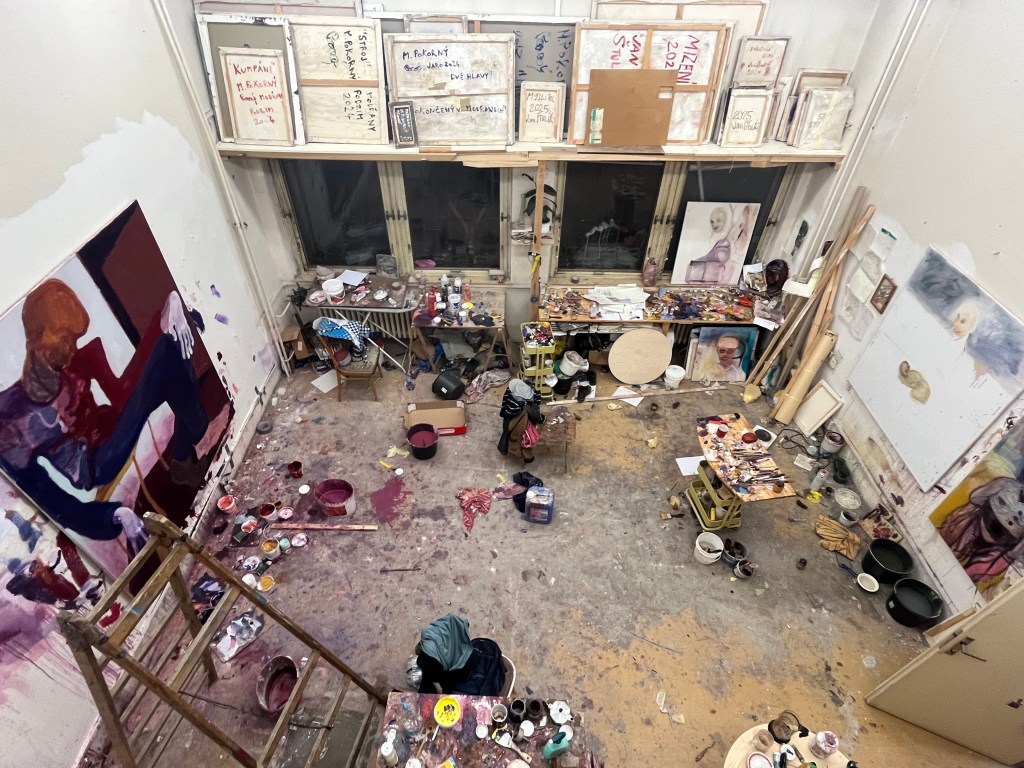
Rigor Mirage
2025
The work of Matěj Pokorný stands at a decisive turning point. It marks a conscious departure from his previous abstract painting and a full-fledged return to figuration, articulated through a newly developed visual language.
The artist himself sees this shift as the formulation of a clearer painterly vocabulary, one that fascinates him with its ability to be both specific and mutable. The theme of transformation becomes a central motif, both
within the figure and in its surrounding space. He explores intensity, explosion, form, destruction. Movement becomes key, a physical release of internal pressure that has no other outlet.
The figure, as a fundamental symbol, is constructed, deconstructed, and blended with flora, organ-like forms, and bones. The body is understood as a field of mutation, transformation, and tension between animality and humanism.
The exhibition RIGOR MIRAGE opens the question of what it means to be human today, at a time when the boundary between human and technology is increasingly blurred. Matěj Pokorný offers a visual reflection on how these shifts affect human identity and self-perception.
The paintings are created quickly, intuitively, like bursts of energy. He returns to them repeatedly, examining, reworking, and deconstructing them. Matter begins to enter the paintings, and Matěj naturally transitions into the medium of sculpture. In this moment, he may step away from painting, but the connection remains deeply felt. His sculptural work is more systematic, yet it retains the same desire for intensity, a form that exists on the edge of collapse. Matter, sculpture, has the power to physically resist, demanding great force from the artist to yield. It becomes a dialogue between the artist and the material.
Our transformation as individuals and as a society is marked by fragility, weakness, neurosis. Matěj Pokorný asks what it means to be human: physically, emotionally, philosophically. It is a theme that remains within him, like a solidified vision to which he returns again and again, offering us glimpses through his ways of seeing.
Filip Kazda
 Matěj Pokorný